

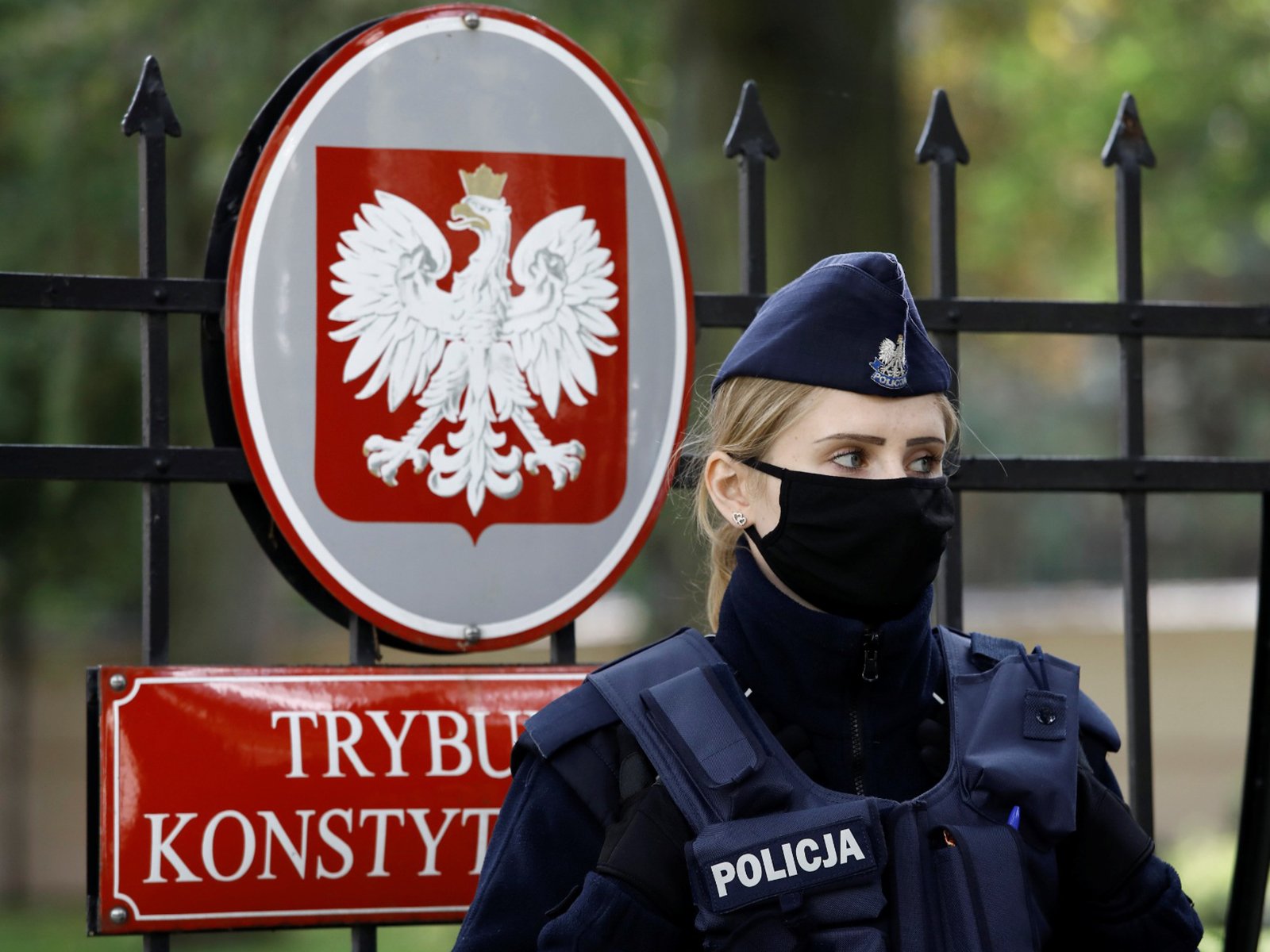
Warsaw [Poland], October 31 (ANI): Poland has plunged into a severe constitutional and political crisis following an intense escalation of the ongoing power struggle between Prime Minister Donald Tusk and President Karol Nawrocki, after heavily armed police units cordoned off the headquarters of the Constitutional Tribunal in Warsaw on Friday night.
A de facto confrontation has erupted within a principal state institution, leaving the final outcome of the standoff uncertain. Law enforcement officers surrounded the premises of the Tribunal in substantial numbers, though they did not physically enter the building.
The deployment of police was requested by Judge Anna Korwin-Piotrowska, who pointed to a potential risk to the safety of judges and administrative personnel.
The crisis intensified rapidly after Korwin-Piotrowska issued a one-month suspension against Constitutional Tribunal President Bogdan Święczkowski and his deputy, Bartłomiej Sochański, thereby temporarily assuming control of the institution.
According to bulletins issued by Poland’s official news agency PAP, the suspensions stemmed from accusations that the two senior figures had improperly discharged their official duties and blocked legally appointed magistrates, including Korwin-Piotrowska, from taking part in the Tribunal’s proceedings.
The official profiles of the suspended figures subsequently vanished from the court’s online portal. In response, the Constitutional Tribunal issued a statement via social media asserting that its website had suffered an “illegal takeover”. It argued that Korwin-Piotrowska lacked the authority to speak for the court and cautioned that those involved were “committing the crime of coup d’état”.
Tensions surrounding the institution have built steadily since early 2026, sparked when President Nawrocki declined to administer oaths to three out of six magistrates selected by Parliament. The broader dispute originates from fundamental disagreements regarding the Tribunal’s membership. The administration headed by Prime Minister Tusk refuses to acknowledge the validity of rulings issued by judges appointed during the preceding Law and Justice (PiS) administration.
Conversely, President Nawrocki and Święczkowski have declined to recognise magistrates chosen by the Sejm in 2026.
Judge Korwin-Piotrowska remains central to this friction, as President Nawrocki previously rejected her oath of office while Święczkowski blocked her participation in hearings. This ongoing political jockeying between the governing Civic Platform (PO) and the former PiS administration has fuelled years of controversy surrounding the court’s legitimacy.
Defending his administration’s position, Prime Minister Tusk insisted that reviving the rule of law remains paramount following years of friction under the previous PiS leadership.
“Restoring the rule of law is our duty. After years of PiS-led lawlessness, this is a difficult process, sometimes painful, and it requires decisive action. There is no other way,” Tusk wrote on X.
The rapidly deteriorating situation forced President Nawrocki to cut short an official mission to Senegal and journey back to Poland. “At such a moment, the President must be in Poland. I’m interrupting my flight to Senegal. I’m returning,” Nawrocki wrote on X. Upon landing, the President is scheduled to hold consultations with Supreme Court President Kapiński regarding the attempted suspension of the Constitutional Tribunal President, according to his Chief of Staff.
Meanwhile, Poland’s Ambassador to China, Jakub Kumoch, tendered his resignation on Friday evening, declaring that “in light of the events in the country”, it was “no longer possible” for him to maintain his diplomatic post.
PiS leader Jarosław Kaczyński censured the Tusk administration, accusing the government of utilising state apparatuses to target the Constitutional Tribunal and warning that the nation was sliding towards authoritarianism.
“From today, Poland becomes a police state, and from there there is already a direct path to authoritarianism, and then to totalitarianism,” he stated.
“The Tribunal is the guarantee of our freedom and sovereignty. Tusk’s trampling of the law knows no limits,” Kaczyński added.
Similar condemnation came from European Parliament members associated with Nawrocki’s Law and Justice party. MEP Arkadiusz Mularczyk characterised the developments as a coup d’état, claiming that agents acting on behalf of the incumbent executive had unlawfully forced entry into the Constitutional Tribunal to bar accredited judges from the premises.
Former Polish prime minister and MEP Beata Szydło also condemned the security operation on social media. “Shocking scenes in Poland. Police, dispatched by the Tusk government, have forced their way into the independent Constitutional Tribunal,” she wrote on X.
She further claimed that security details protecting the building and judicial records were dismissed, while the court’s vice-president was barred from entering.
This latest confrontation marks a dramatic escalation in Poland’s protracted institutional deadlock, with rival factions maintaining starkly conflicting viewpoints concerning the government’s intervention and the legal standing of the Tribunal’s leadership. (ANI)
